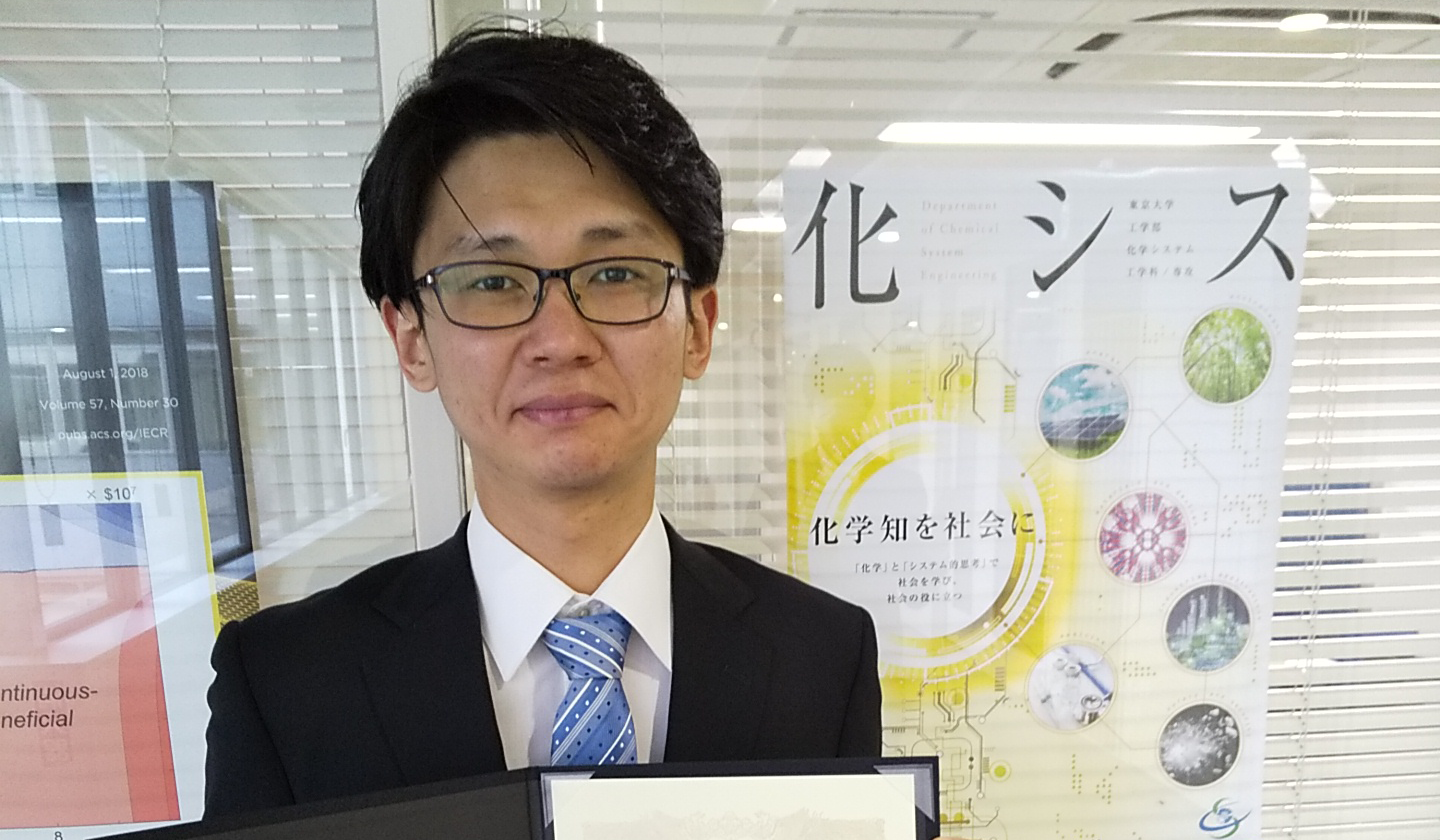
On 4th September 2026, Lecturer Fuminao Kishimoto, Department of Chemical System Engineering, received The 15th Young Scientist Award, Specific Synchrotron Radiation Facilities Users Community (SpRUC)

Award ceremony at the Specific Synchrotron Radiation Facilities Symposium 2026
The 15th Young Scientist Award, Specific Synchrotron Radiation Facilities Users Community (SpRUC)
Young Scientist Award (YSA) is presented to a young researcher who has made a notable contribution through the development of a new experimental technique or a novel method of data analysis, or who has achieved remarkable results in their field of study by leveraging the unique capabilities of SPring-8, SACLA, or NanoTerasu.
About awarded research
Our research group is developing next-generation chemical reactors powered by microwave energy, with the goal of establishing clean chemical manufacturing processes that do not rely on fossil fuel combustion. Developing these new reaction technologies requires an accurate understanding of what happens at the atomic level during chemical reactions.
The award-winning research builds on a new experimental method we developed at SPring-8, a large synchrotron radiation facility in Hyogo Prefecture, Japan. We focused on using high-energy X-rays above 100 keV to probe atomic arrangements in materials. After several years of trial and error, we developed a custom-designed microwave heating cell and established an in situ high-energy X-ray total scattering method that allows us to observe atomic arrangements during microwave irradiation.
Using this method, we demonstrated a new concept called “microwave single-ion selective heating,” in which specific ions are selectively heated, and published the first demonstration of this concept. We then applied it to catalytic reactions, including methane conversion and carbon dioxide reduction, demonstrating that these reactions could be controlled through this approach. These findings established a new method for controlling catalytic reactions using microwaves.
Your impression & future plan
In recent years, the development of microwave-powered chemical reactors by startups and other companies has accelerated, particularly in Europe and North America. For Japan to keep pace with this trend and develop distinctive technologies, we believe it is essential to unravel the phenomena unique to microwaves that go beyond simply replacing a conventional heat source, and to steadily advance applied research grounded in a sound fundamental understanding.
Encouraged by this award, our research group will continue building the scientific foundations needed to understand microwave-driven chemical reactions at the atomic level. We also aim to translate these insights into practical applications and deliver outcomes that contribute to cleaner chemical manufacturing processes.
The 15th Young Scientist Award, Specific Synchrotron Radiation Facilities Users Community (SpRUC):

Yusuke Watanabe (M2), Department of Bioengineering, received Best Poster Award, The 32nd International Symposium of TMIMS, The 4th Ploidy Meeting

Hiroshi Uemura (D3), Department of Urban Engineering, received Best Paper Award at The 15th Asia-Pacific Conference on Transportation and the Environment