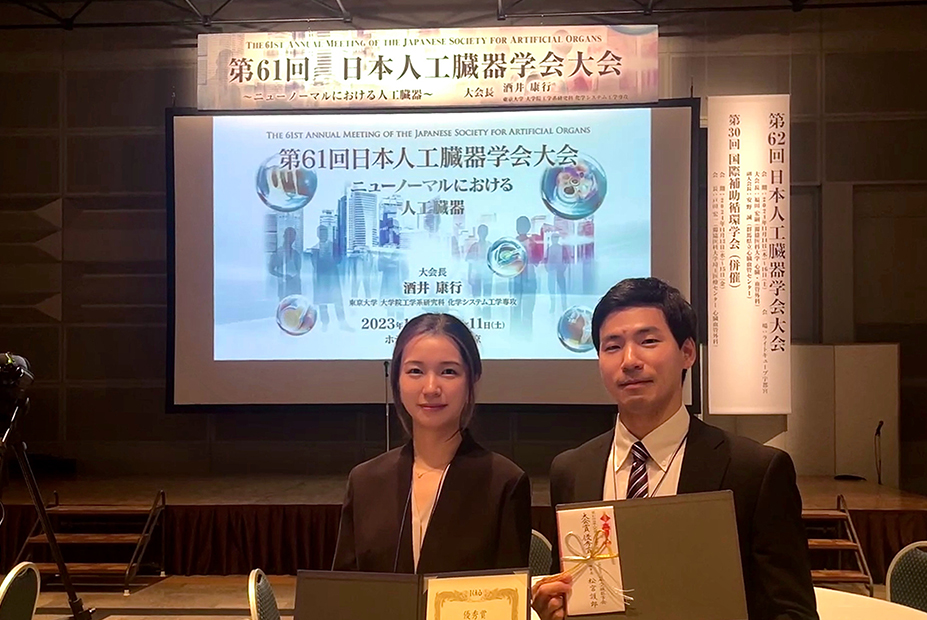
On 24th September 2026, Wei Yicheng (D3), Sakai-Nishikawa Lab., Department of Bioengineering, received Best Poster Award at The 2026 Asia-Pacific Summit of International MPS Society & 9th Academic Conference on Organoid and Organs-on-Chip.


Best Poster Award at The 2026 Asia-Pacific Summit of International MPS Society & 9th Academic Conference on Organoid and Organs-on-Chip
This award was established to recognize outstanding poster presentations at an Asia-Pacific academic conference organized by the International MPS (Micro-Physiological System) Society. Posters were evaluated based on their research content, originality, and academic significance, and this work was selected for the Best Poster Award.
About awarded research
“Size-Dependent Restriction of Microplastic Translocation in an In Vitro Large-Pore Intestinal Co-Culture Model.”
Micro- and nanoplastics (MNPs) have raised increasing concerns regarding their potential effects on human health, yet the intestinal translocation of relatively large microplastics remains poorly understood. In conventional in vitro intestinal models, small membrane pores may physically restrict particle transport, potentially leading to an underestimation of intestinal translocation.
In this study, we developed a large-pore intestinal model by co-culturing Caco-2 cells and intestinal myofibroblasts on a 30 µm nylon mesh. The model exhibited stable transepithelial electrical resistance (TEER) and low FITC-dextran permeability, demonstrating the formation of a functional epithelial barrier despite the large openings of the supporting mesh.
Following 48 hours of exposure, 1 µm microplastics showed measurable translocation, with significantly higher relative transport than in the conventional model. In contrast, no translocation was detected for 12 or 22 µm particles, demonstrating a strong size-dependent restriction by the intestinal epithelial barrier. These findings also indicate that the physical properties of the culture support should be considered when evaluating microplastic intestinal translocation.
Future work will incorporate an artificial mucus layer to investigate how mucus-particle interactions, including particle retention and physicochemical changes, influence intestinal transport. The model will be further developed toward a more physiologically relevant intestinal system to improve our understanding of MNP translocation and its application to human health risk assessment.
Your impression & future plan
I would like to express my sincere gratitude to Professor Yasuyuki Sakai and all members of the Sakai-Nishikawa Laboratory for their continuous guidance and support throughout this research. I would also like to thank the researchers at the conference for their valuable comments and constructive feedback.
Encouraged by this award, I will continue to develop the in vitro intestinal model established in this study and deepen our understanding of the intestinal fate and translocation of MNPs. Ultimately, I aim to connect these experimental findings with human health risk assessment and contribute to the development of reliable approaches for evaluating the potential health effects of MNP exposure.