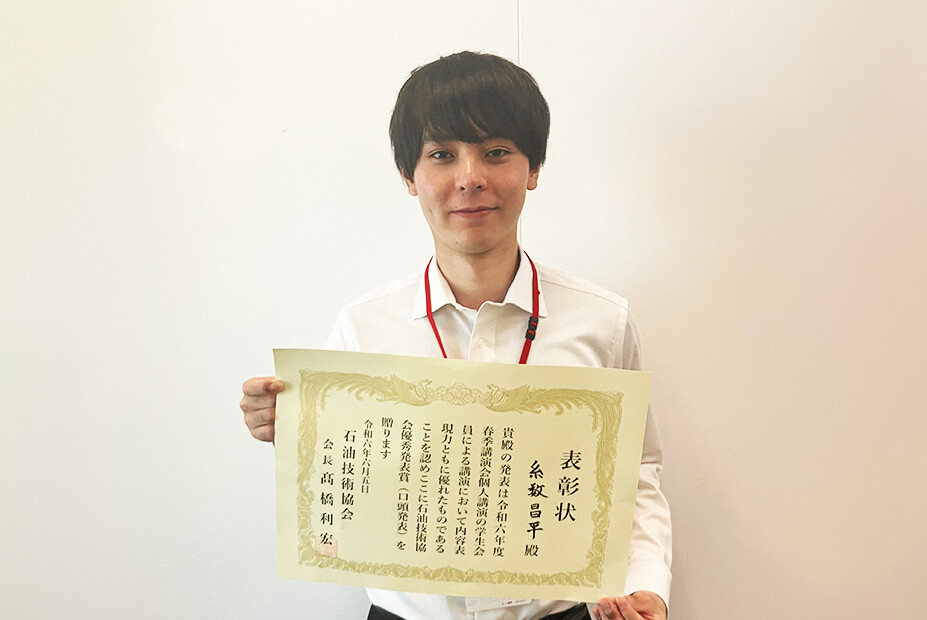
On 5th June 2026, Project Research Associate Ryo Takahashi, Department of Electrical Engineering, received IEEE RA-L 2025 Best Paper Award.


IEEE RA-L 2025 Best Paper Award
The paper "Joint-Repositionable Inner-Wireless Planar Snake Robot" in IEEE Robotics and Automation Letters, 10 (5), pp. 4994-5001 (2025) by Associate Professor Ayato Kanada (The University of Electro-Communications)*, Project Research Associate Ryo Takahashi* (*co-first) et al. has been selected as one of only five Best Paper Awards out of more than 1,700 papers published in RA-L during 2025. This recognition, determined by the RA-L Editorial Board and Editor-in-Chief, reflects the outstanding contribution to the field of robotics and automation.
About awarded research
Snakes can move freely through narrow gaps and complex obstacles by smoothly undulating their bodies. If these capabilities can be replicated in robots, they are expected to play a crucial role in environments that are inaccessible to humans and cluttered with debris, such as search-and-rescue operations at disaster sites or inspections of aging pipelines. However, current snake-like robots cannot move as freely as real snakes. The primary reason for this limitation lies in the difference in the "number of joints." While biological snakes possess hundreds of vertebrae, conventional snake robots typically have only a dozen or so joints, resulting in rigid, polygonal movements. On the other hand, simply increasing the number of joints requires more motors and wiring, making the robot extremely heavy. Consequently, balancing smooth motion with a lightweight design has been a persistent challenge.
To address this issue, a research group from The University of Electro-Communications, The University of Tokyo, and Kyushu University has developed a novel robotic mechanism that "repositions joint functions to where they are needed." In conventional robots, motors are fixed at each specific joint. In contrast, the newly developed robot introduces an innovative mechanism that allows the motors to move inside the robot's body rather than being fixed. For instance, when the robot needs to bend its front section, the motor moves forward; when it needs to bend its midsection, the motor moves to the center, bending the body at that precise location. This approach achieves smooth, snake-like locomotion with many joint configurations while utilizing only a minimal number of motors. Furthermore, to prevent motor wiring from hindering the robot's movement, the team developed a soft robotic skin equipped with a wireless power transfer mechanism integrated into its flexible outer shell. This allows for contactless power delivery to the moving motors without the need for tethered power cables.
Video link: https://youtu.be/rYP4NYgidbw
Your impression & future plan
I am very honored to receive this award. I would like to thank all of our collaborators who have worked with us on this challenging research and who have supported us in our research lives. I hope this paper will contribute to the future development of soft robots.
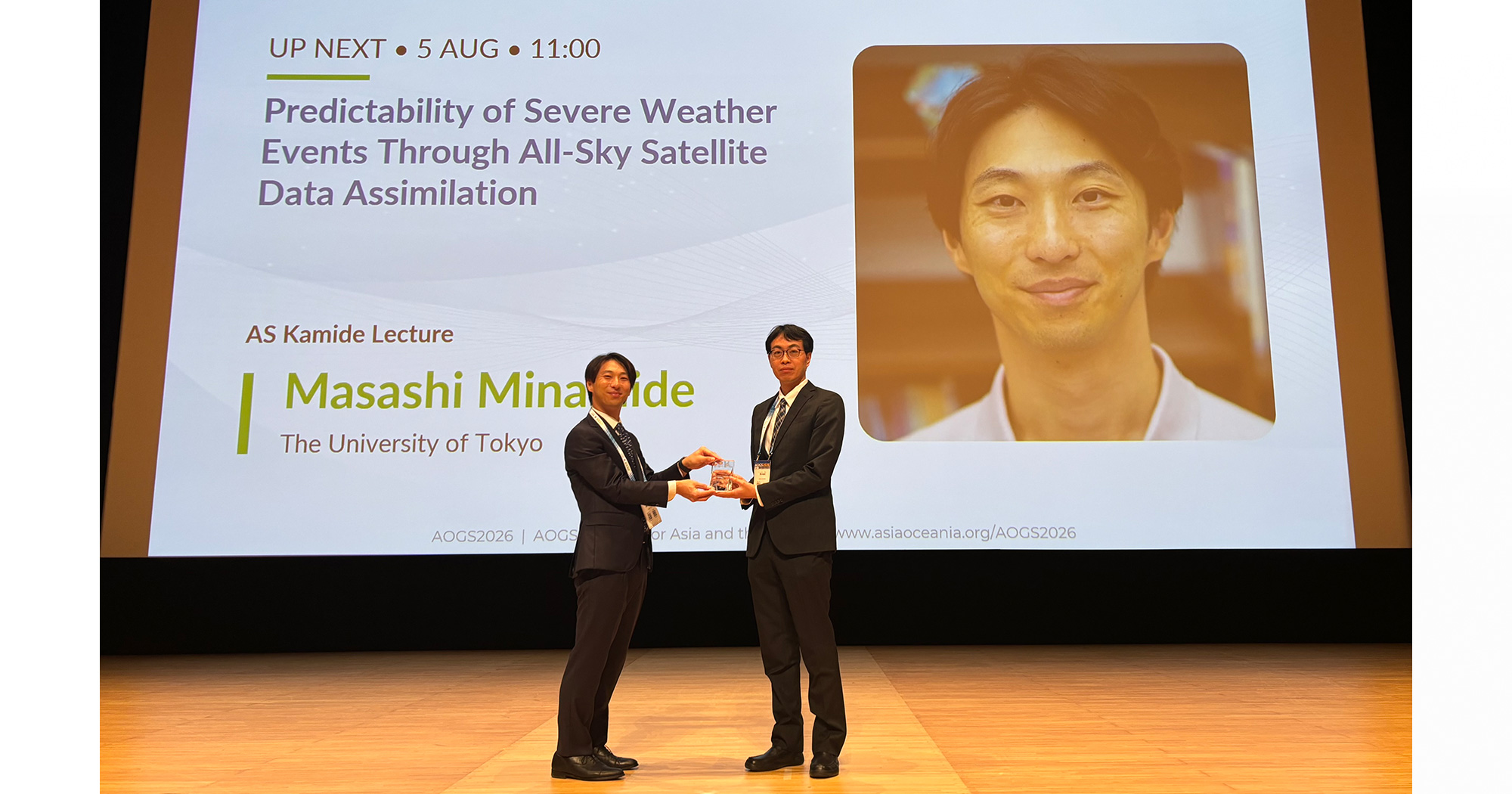
Project Associate Professor Masashi Minamide received AOGS2026 Kamide Lecture Award
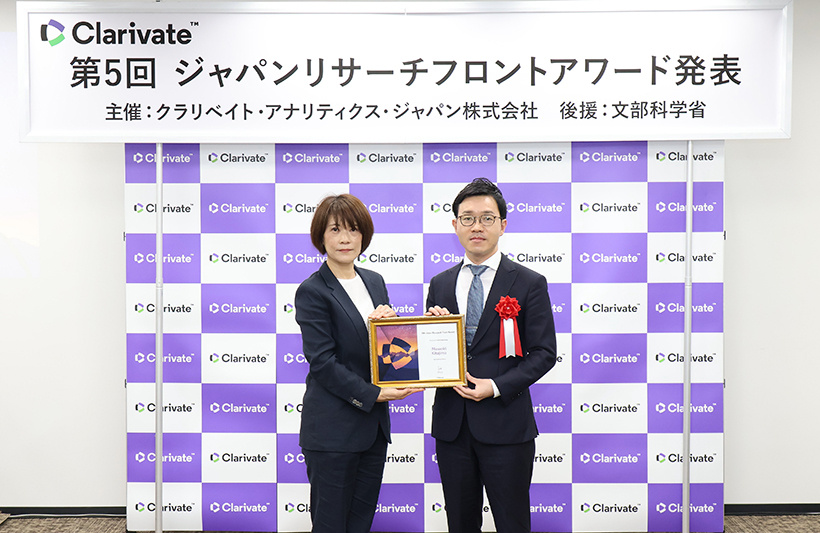
Project Professor Masaaki Kitajima received 5th Japan Research Front Award