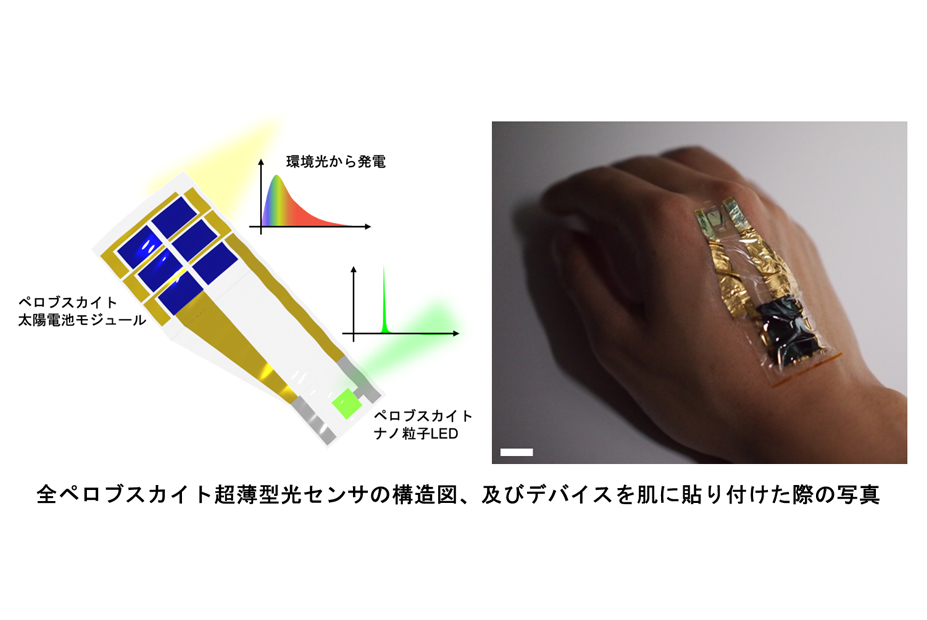
Using metal–organic chemical vapor deposition (MOCVD), the research team has discovered two key growth mechanisms for monolayer MoS2 on sapphire substrates: self-aligned coalescence of MoS2 crystal grains and self-limiting growth of the film thickness.
At the early stage of growth, numerous MoS2 nuclei form with various crystallographic orientations. Through the self-alignment mechanism, however, these grains merge while simultaneously transforming into a single crystal. As a result, wafer-scale epitaxial growth of single-crystal monolayer MoS2 films can be achieved with high reproducibility. Furthermore, analysis of the temperature dependence of the electron mobility demonstrates that MoS2 possesses high crystalline quality with a low defect density.
Moreover, it was also found that the reaction characteristics of the selected molybdenum precursor, MoO2Cl2, enable self-limiting growth, in which crystal growth naturally terminates at a single atomic layer. This unique behavior cannot be realized by conventional CVD methods. Even when the growth time is extended, the formation of a second layer is strongly suppressed, and excellent thickness uniformity is maintained across a 2-inch scale. This self-limiting thickness mechanism is expected to be highly beneficial for atomic-layer film formation on large-diameter wafers up to 300 mm.
This achievement opens a pathway toward the stable, wafer-scale production of high-quality and uniform single-crystal two-dimensional semiconductor films. It represents a significant step forward for future applications in large-scale integrated circuits, low-power electronics, and optoelectronic devices.

Monolayer MoS2 single crystal grown on sapphire substrate & field-effect transistor devices
Papers
Journal: Nature Communications
Title: Self-aligned and self-limiting van der Waals epitaxy of monolayer MoS2 to annihilate grain boundaries for scalable 2D electronics
Authors: Yoshiki Sakuma*, Keisuke Atsumi, Takanobu Hiroto, Jun Nara, Akihiro Ohtake, Yuki Ono, Takashi Matsumoto, Yukihiro Muta, Kai Takeda, Emi Kano, Toshiki Yasuno, Xu Yang, Nobuyuki Ikarashi, Asato Suzuki, Michio Ikezawa, Shuhong Li, Tomonori Nishimura, Kaito Kanahashi, Kosuke Nagashio*
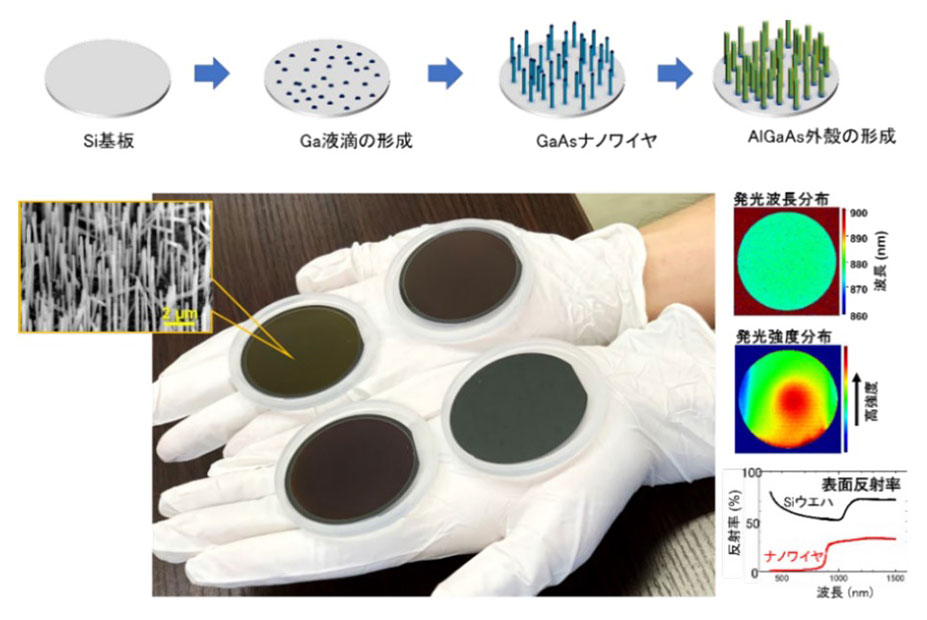
Wafer-scale integration of GaAs/AlGaAs core–shell nanowires on silicon by the single process of self-catalyzed molecular beam epitaxy
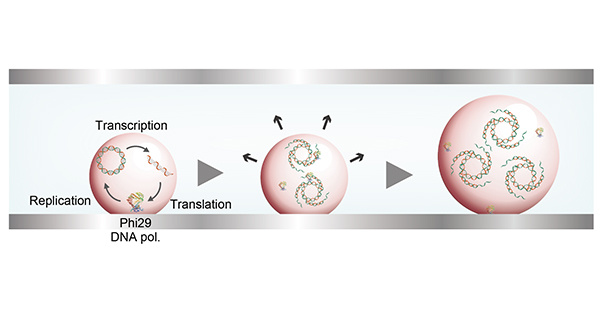
Development of Self-Growing Protocell Model: Exploiting the Stabilization of Phase Separation by DNA