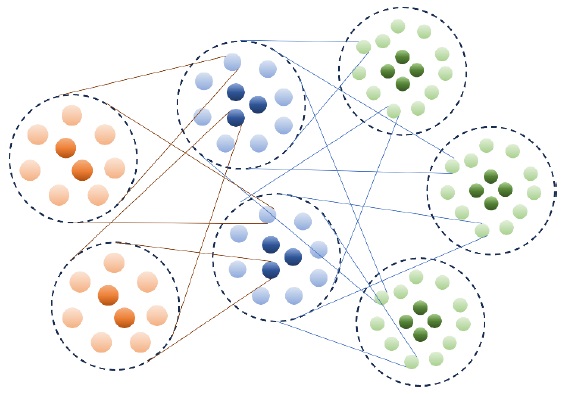
Researchers have long argued that complex systems—like the human brain—often function best near the boundary between order and chaos, a regime known as the “edge of chaos.” This notion helps explain rich phenomena across disciplines, spanning ecosystems and social dynamics to computation and biological intelligence. For example, mathematical models in neuroscience suggest that the human brain operates best near this boundary; similarly, ecological models demonstrate optimal flexibility in adapting ecosystems. Along the same lines, reservoir computing, a machine learning framework inspired by brain function, is often reported to achieve its best performance in this regime. Collectively, these findings have fueled the view that the edge of chaos may be a broadly applicable principle underlying complex collective behavior in nature and technology—at least in classical systems.
In this research, the research team extends this concept to the quantum realm. They study quantum reservoir computing (QRC), the quantum counterpart of conventional reservoir computing, which harnesses natural quantum dynamics as a “brain” for information processing. Despite rapid progress, the field has long faced a central question: what properties make a quantum system particularly well-suited for QRC? The team argues that the answer mirrors the classical story. They show that QRC likewise reaches peak performance near the quantum analogue of the edge of chaos, which they term the “edge of many-body quantum chaos.” Beyond identifying a guiding principle for designing and understanding QRC, this result suggests a more unified picture of complex behavior across classical and quantum systems through a shared notion of the edge of chaos.

Concept of the edge of chaos in (a) classical and (b) quantum systems
Papers
Journal: Physical Review Letters
Title: Edge of Many-Body Quantum Chaos in Quantum Reservoir Computing
Authors: Kaito Kobayashi*, Yukitoshi Motome
DOI: 10.1103/j2qj-vwcl
Large non-reciprocal charge transport mediated by quantum anomalous Hall edge states
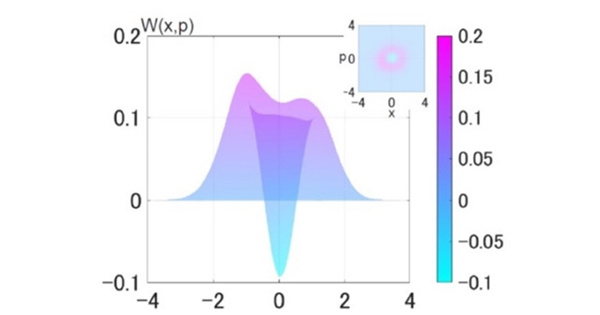
High-speed generation of optical quantum state: Acceleration of optical quantum computers via optical communication technology