

The Portable Active Seismic Source (PASS), developed by Professor Takeshi Tsuji’s research group at the University of Tokyo, has been selected for development as the active seismic source for NASA’s Artemis IV mission. PASS is a lightweight, compact, and highly operable seismic source that has been refined through its use in CO₂ storage monitoring, civil engineering surveys, and subsurface investigations on Earth. For Artemis IV, a space-qualified version of PASS has been jointly developed by the University of Tokyo and JAXA, optimized for astronaut operation on the lunar surface.

The South Pole Seismic Station (SPSS)—a seismic instrument package developed under the leadership of NASA’s Jet Propulsion Laboratory (JPL) in collaboration with CNES and IPGP, is being designed for deployment by astronauts on the Artemis IV mission. PASS will allow astronauts to generate controlled seismic waves near the deployed seismometers, to image the subsurface structure around the landing site. The mission mainly aims to construct high-resolution S-wave velocity profiles to depths of several meters, providing essential data for characterizing lunar regolith, assessing ground conditions for future lunar infrastructure and base construction, and identifying potential water or mineral resources. These seismic observations will also contribute to advancing scientific understanding of the Moon’s formation and near-surface evolution.
Building on this mission, the research group will continue to advance seismic exploration technologies suited for lunar and planetary environments, while further promoting the use of compact active-source systems for subsurface investigations on Earth.
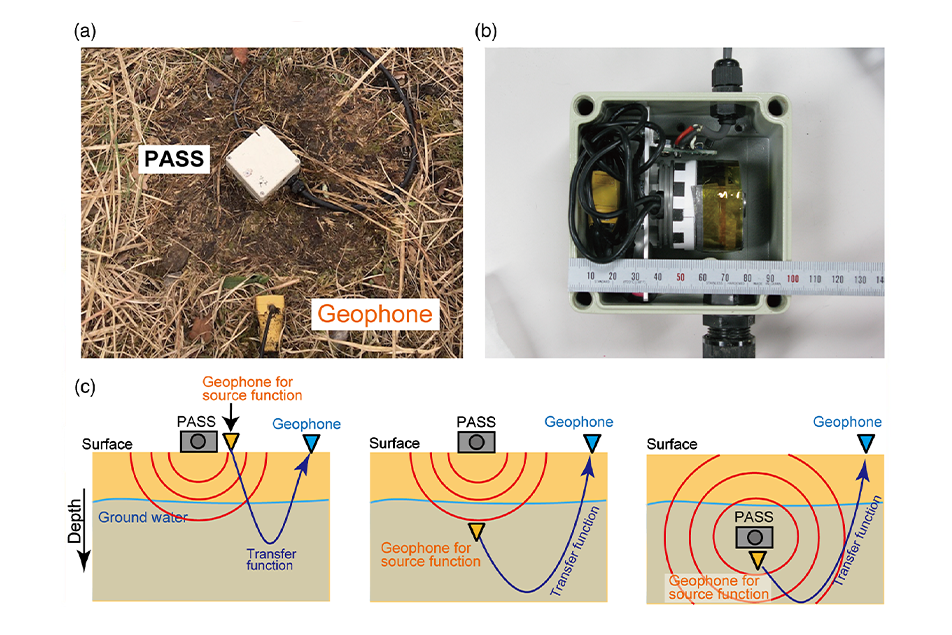
4 cm Portable Active Seismic Source (PASS) for Meter-to Kilometer-Scale Imaging and Monitoring of Subsurface Structures

A compact, low-impact seismic source reshapes monitoring of offshore CO₂ storage
