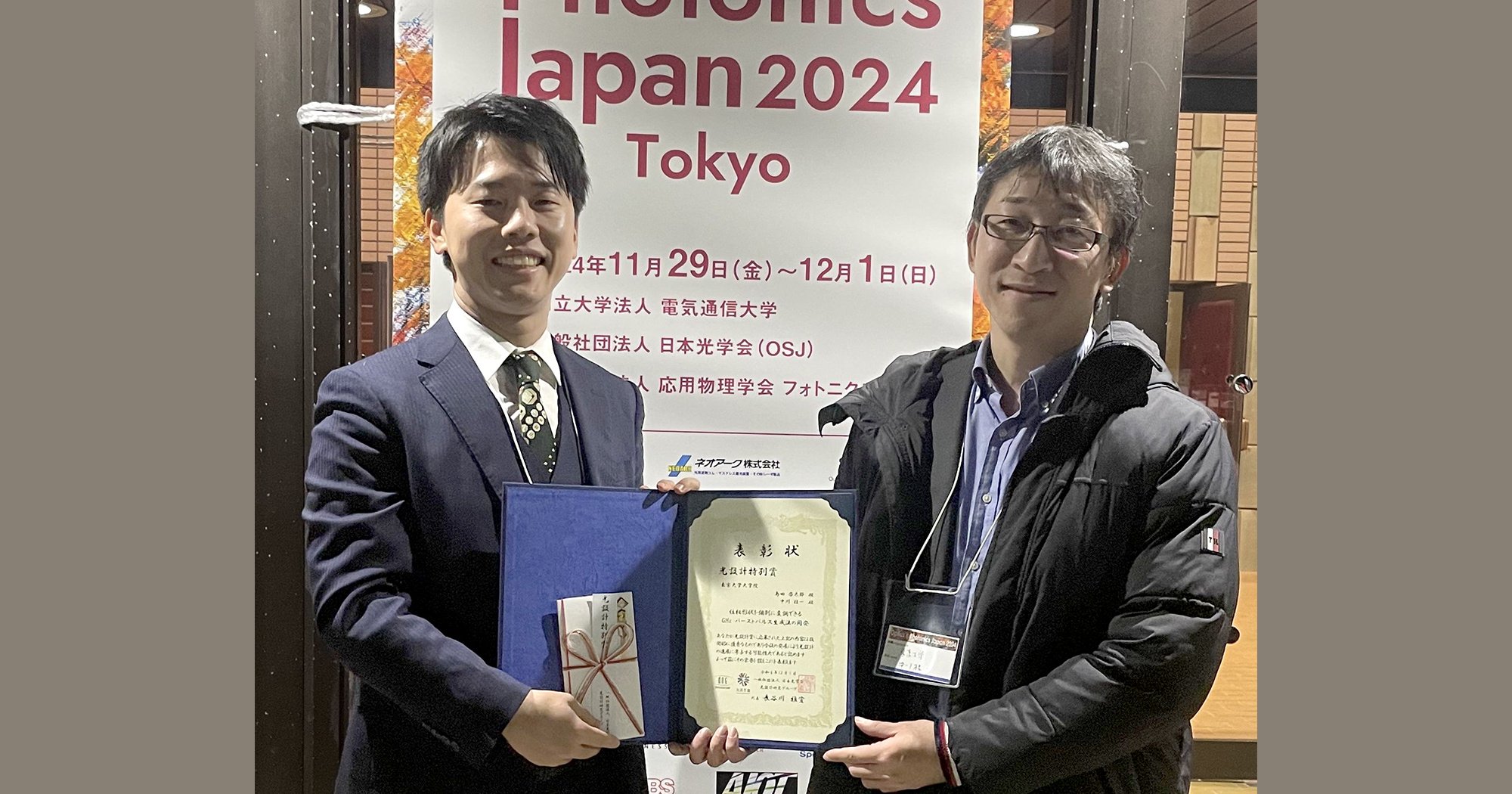
On 15th March 2026, Sanshiro Uyama and Keisuke Wada (M2 at the time of award), and Taro Kawano (B4 at the time of award), Department of Urban Engineering, received Best Presentation Award.

Best Presentation Award, 32nd Annual Conference of the Japan Society for Disaster Information Studies
This award is given to best presentations by young researchers and students aged 40 or younger at the annual conference of the Japan Society for Disaster Information Studies.
About awarded research
【UYAMA】
Title: Exploring the Casual Factors Behind Direct and Disaster-Related Deaths from Earthquakes
Overview
Despite extensive measures to reduce deaths from earthquakes, recent earthquakes in Japan have still resulted in both direct deaths and disaster-related deaths. This suggests that fatalities caused by earthquakes may be shaped by underlying background factors overlooked by existing measures. This study therefore explores the causal relationships among background factors influencing the occurrence of fatalities caused by earthquakes—both direct and disaster-related deathsーfocusing on the 2016 Kumamoto Earthquake and the 2024 Noto Peninsula Earthquake.The results reveal that several variables not considered in current measures may serve as background factors influencing fatalities. For direct deaths, these aging rate and the number of firefighting personnel may be the background factors. As for disaster-related deaths, variables such as the number of physicians, pharmacists, construction establishments, and response time to incident sites were identified as potential background factors. These findings may contribute to the development of more effective strategies for reducing fatalities in the future.
【WADA】
Title: An Economic Damage Analysis of a Mount Fuji Eruption and Ashfall Using a SCGE Model
Research Summary:
Volcanic disasters occur relatively infrequently, and compared with earthquakes or floods, there may be fewer opportunities to recognize them as an immediate disaster risk. However, once a large-scale eruption occurs, it is said to affect a wide geographic area. Among the various impacts of volcanic eruptions, volcanic ash carried by the wind can extend its effects even to major cities far from the volcano itself.
This study estimates the regional economic damage that would occur if an eruption on the scale of the Hoei eruption of Mount Fuji—which brought a large amount of volcanic ash to Edo approximately 300 years ago—were to occur in the present day. Specifically, the study compiles the damage to infrastructure and industry and estimates the monetary losses for each region. Attention is given to the ripple effects caused by declines in corporate production activity, with an emphasis on how economic damage spreads from ashfall-affected regions to other regions that are not directly impacted by ash deposition. By quantitatively estimating the damage for each region, this study is expected to contribute to future volcanic ash countermeasures and business continuity planning (BCP). Furthermore, by identifying the regions and industries that should be prioritized, it may help support the rapid recovery of economic activity after an eruption.
【KAWANO】
Title: An Analysis of the Allocation of Constructed Temporary Housing and Temporary Industrial Facilities in the Event of a Tokyo Inland Earthquake
Overview
In the event of a Tokyo inland earthquake, large-scale demand would arise not only for temporary housing due to housing damage, but also for temporary industrial facilities, such as temporary factories, to sustain economic activity. However, in the Tokyo metropolitan area, the amount of land available for construction is limited, making it a critical issue how scarce land should be allocated between housing and industry. Existing studies have often treated housing and industry separately, and in practice, administrative responsibilities are also divided across different departments. As a result, little attention has been paid to how housing and industry interact and compete when land is severely constrained.
This study focuses on the dilemma between housing and industry arising from the limited supply of land. It clarifies the trade-off relationship between the extent to which housing demand can be met and the extent to which employment can be restored. In addition, the study identifies which industries are more likely to compete for land and reveals the areas where land shortages are expected to become particularly severe. These findings are expected to contribute to the examination of land allocation strategies that integrate both housing and industrial needs in the event of a Tokyo inland earthquake.
Your impression & future plan
【UYAMA】
I am deeply honored and delighted to receive the award. This research was conducted as part of my master’s thesis, and I have been fortunate to receive support throughout the process. I would like to express my sincere gratitude to everyone who has supported me, as this achievement would not have been possible without their guidance and encouragement. Especially, I would like to thank my supervisors and senior students in the laboratory for their continuous and thoughtful guidance. They provided generous support whenever I faced difficulties in my research.
【WADA】
I am truly honored to have received the Excellent Presentation Award. I strongly feel that this recognition is not the result of my efforts alone, but rather the outcome of the guidance of my professors and the support of my lab colleagues and junior students, with whom I was able to learn and grow together. I would like to express my sincere gratitude once again.
This research, which estimates the economic damage caused when infrastructure and industry are disrupted by volcanic ashfall, dealt with a relatively niche field both in terms of disaster type and analytical methodology. Nevertheless, I am deeply grateful to those who actively engaged in discussion during the presentation and to those who evaluated the work so highly. I believe that the struggles I experienced in reaching this point, and the fact that those efforts ultimately bore fruit in the form of this award, will remain a lasting source of confidence for me no matter what field I pursue in the future.
【KAWANO】
I am deeply honored to have received this prestigious award. I am sincerely delighted that my very first academic conference presentation was recognized in this way.
I would also like to express my heartfelt gratitude to my professors and everyone in my laboratory for their careful guidance and support throughout this research.
At present, this study remains at the stage of providing an overview of the post-disaster situation following a Tokyo inland earthquake, and I recognize that more detailed and refined analysis will be necessary in the future. Encouraged by this award, I will continue to devote myself earnestly to further research.

Yuki Horikawa (B4 at the time of award) and Hiroya Mitachi (B4 at the time of award), Department of Systems Innovation, received the Grand Prix at the 2nd Information Health AWARD
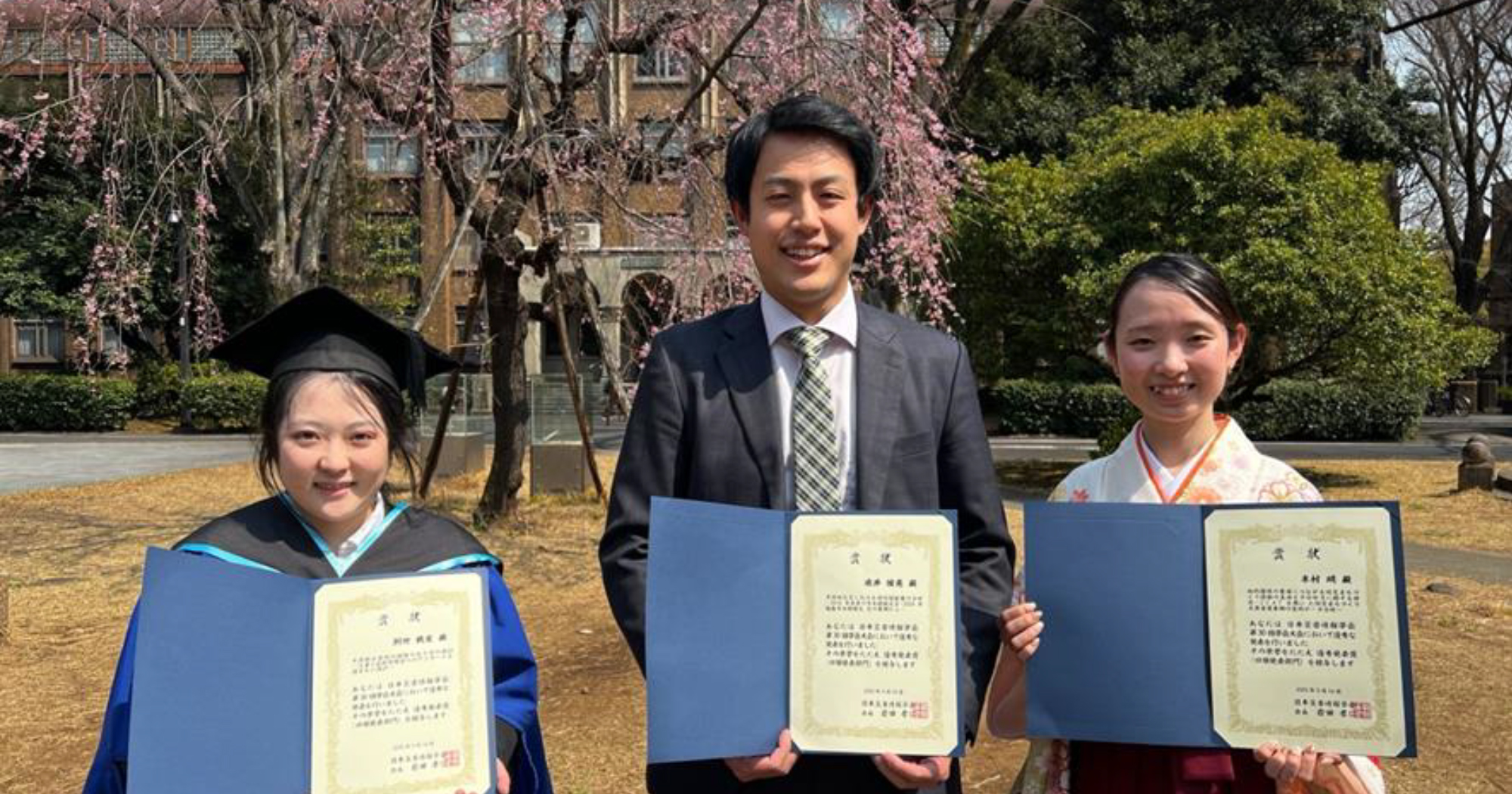
Mei Kimura (B4), Momomi Noritake (M2), and Shunsuke Narui (Research Student), Deptartment of Urban Engineering received Best Presentation Award