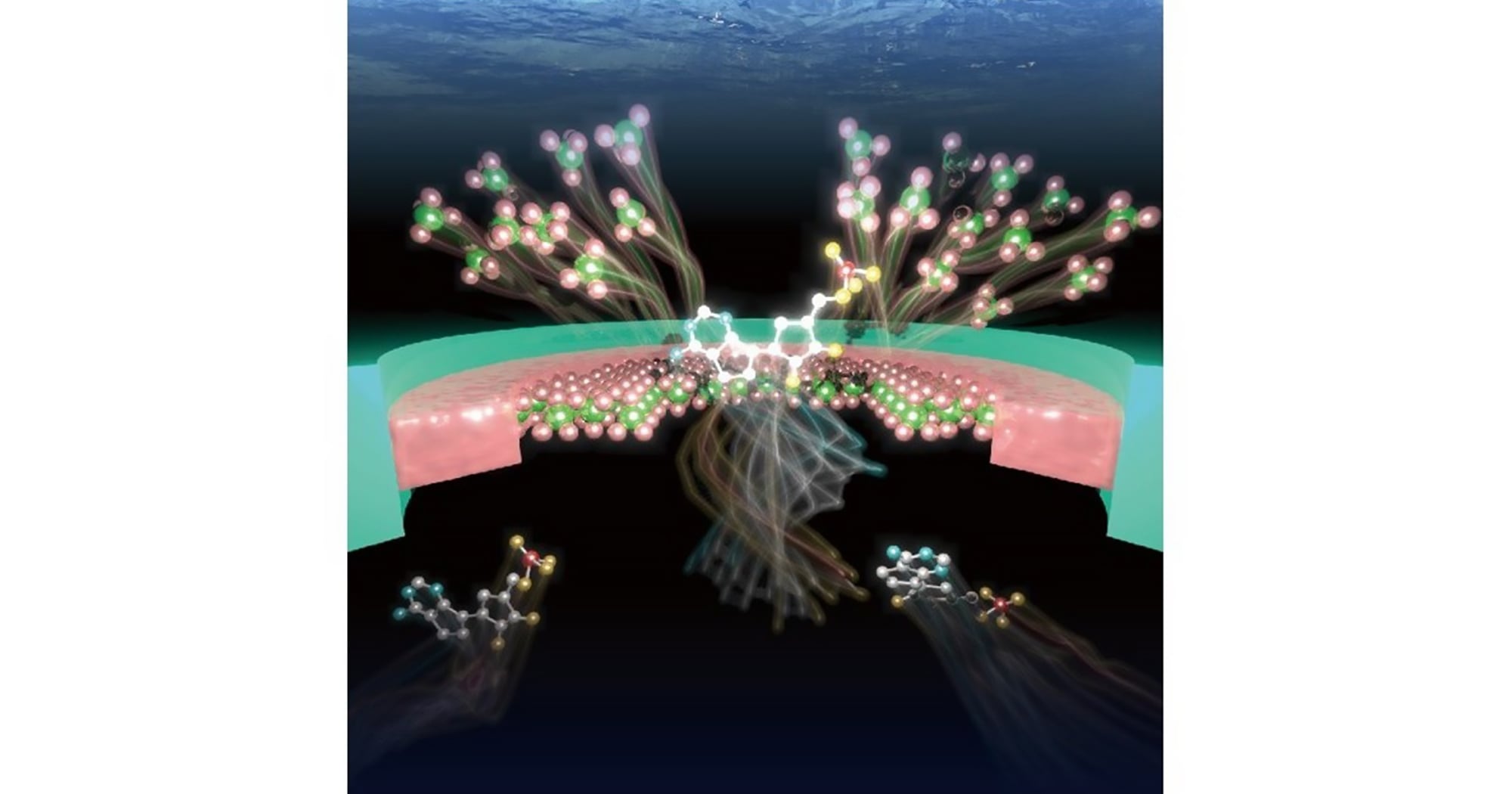
Polymerization reactions that occur on solid surfaces are vital processes used in countless everyday applications, such as adhesives, coatings, and even SEI (solid-electrolyte interphase) layers that govern the performance of modern batteries. While it has become clear in recent years that these ultra-thin films have a significant impact on how materials function, their exact structures and the mechanisms by which they form have remained largely unknown. This is primarily because these films often grow spontaneously only at the material interface, making them difficult to observe and control.
In this study, the research team discovered that a strong supramolecular interaction with a solid surface dramatically increases the molecule's reactivity. This interaction allows only the molecules directly touching the electrode to undergo polymerization. As a result, a polymer film with a thickness of a single molecule is formed, after which the reaction automatically stops on its own. In the field of metal plating, there is a well-known technique called Underpotential Deposition (UPD) that creates a single layer of atoms. This research has successfully demonstrated, for the first time, that a similar principle can be applied to polymer formation, a process termed as Underpotential Electropolymerization (UPEP).
These findings were supported by both theoretical calculations and electrochemical experiments. The team discovered that when using a gold electrode, molecules such as thiophenes and pyrroles become highly activated on the surface, allowing the reaction to proceed at a much lower voltage than previously thought possible. Interestingly, this specific reactivity was not observed with carbon or platinum electrodes, even for the same molecules. This proves that the unique interaction between the molecule and the specific solid surface is the "secret key" that drives this precise chemical process.
This research opens up new possibilities for material design by focusing on these surface-specific interactions. For instance, it provides a new perspective on improving the SEI layers that are crucial for battery life and for creating high-performance adhesives. It could also offer a solution to marine infrastructure issues; since the attachment of barnacles to ships is triggered by surface polymerization, these findings could lead to materials that prevent this buildup and reduce fuel costs. Furthermore, because this method can selectively synthesize films just one molecule thick, it holds great promise for creating "two-dimensional polymers"—materials that are attracting global attention for their extraordinary physical properties.

Self-Terminating Polymerization Realized by Monomer-Electrode Interaction
Papers
Journal: Journal of the American Chemical Society
Title: Realization of self-terminating underpotential electropolymerization by strong supramolecular monomer-electrode interaction
Authors: Yudai Yokoyama, Yuzu Kobayashi, Yasuyuki Yokota, Yasunobu Ando, and Yoshimitsu Itoh*
DOI: 10.1021/jacs.6c03733
Ultrastrong underwater adhesion on diverse substrates using non-canonical phenolic groups
Autonomous molecular sensing with a chemically stateful solid-state nanopore: Toward next-generation single-molecule sensors capable of distinguishing between DNA bases and amino acids