

A research team has developed a new way to fabricate high-quality FeTe thin films by using a technique called molecular beam epitaxy (MBE), where a crystal substrate is exposed to beams of vaporized elements in an ultra-high-vacuum environment. Normally, when the atomic spacing of the film and substrate differs too much, the resulting strain creates defects. In rare cases, however, a phenomenon known as higher-order epitaxy can occur: the two crystals align not unit-cell by unit-cell, but by matching larger integer multiples of their lattice patterns. Although this effect has been known for decades, it has seldom been useful because it typically produces disordered films.
In this study, the research team discovered that FeTe films on CdTe substrates—despite their large lattice mismatch—become unexpectedly highly crystalline. Advanced electron microscopy revealed a self-organized pattern of periodic interstitial atoms near the interface. These atomic “nodes” (the red areas in the left figure) help stabilize the unexpected higher-order lattice matching and improve the overall film quality.
The resulting FeTe films show almost no monoclinic distortion and, strikingly, become superconducting (the right figure), unlike ordinary bulk FeTe. Because the films are chemically simple and structurally well controlled, they may provide an ideal platform for exploring exotic quantum states, including the possible emergence of Majorana fermions in a clean, stoichiometric superconducting system.

Higher-order epitaxial interface and emergent superconductivity in FeTe/CdTe film.
Papers
Journal: Nature Communications
Title: Superconductivity and suppressed monoclinic distortion in FeTe films enabled by higher-order epitaxy
Authors: Yuki Sato, Soma Nagahama, Shunsuke Kitou, Hajime Sagayama, Ilya Belopolski, Ryutaro Yoshimi, Minoru Kawamura, Atsushi Tsukazaki, Naoya Kanazawa, Takuya Nomoto, Ryotaro Arita, Taka-hisa Arima, Masashi Kawasaki, and Yoshinori Tokura
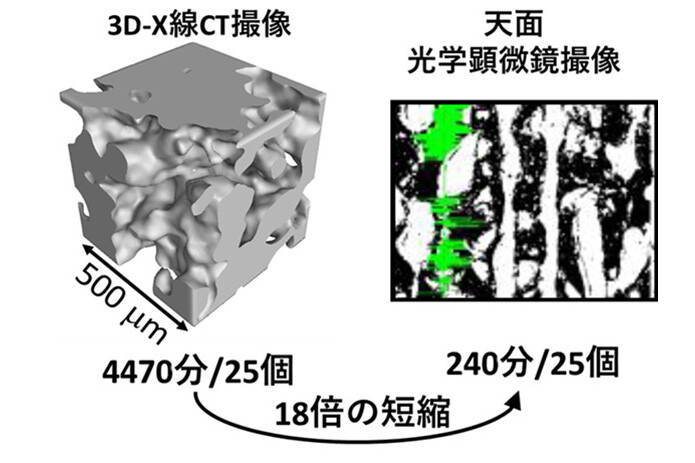
One-shot acquisition of intermediate feature values for in-process parameter exploration in PBF-LB of ultrafine porous metallic structure

Metasurface-Based Compact Optical Device for Advanced Beam Multiplexing
