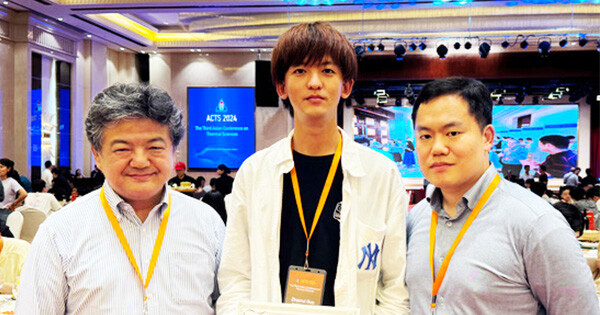
On 3rd November 2025, Shohei Kaneko (D2), Sakai-Nishikawa Lab from Department of Chemical System Engineering, received ESTIV Award at the 38th annual meeting of the Japanese Society for Alternatives to Animal Experiments.

ESTIV Award at the 38th annual meeting of the Japanese Society for Alternatives to Animal Experiments
This award was established to promote international exchange between the European Society of Toxicology In Vitro (ESTIV) and the Japanese Society for Alternatives to Animal Experiments (JSAAE). Based on submitted poster presentation abstracts, representatives from ESTIV selected four finalists. After English oral presentations and evaluation, two award recipients were chosen.
About awarded research
The research title is “Prediction of the effects of microplastics on the human body using a physiologically based pharmacokinetic (PBPK) model with a focus on immune cells.” In recent years, traditional chemical risk assessment relying on animal experiments has been challenged due to interspecies differences and ethical concerns regarding animal use. In response, alternative approaches that do not depend on laboratory animals—such as in vitro studies using cultured cells or tissues and in silico analyses using computer simulations and bioinformatics—have been promoted, primarily in the United States and Europe, under the framework of New Approach Methodologies (NAMs). Furthermore, these approaches are increasingly being integrated into comprehensive evaluation strategies known as Next Generation Risk Assessment (NGRA). The assessment of human health risks posed by nano- and microplastics, which have recently gained global attention, is no exception; establishing evaluation methods that do not rely on animal testing is urgently needed.
In this study, we developed a PBPK model, in which the movement of microplastics within the human body is described using ordinary differential equations based on actual physiological parameters, including organ volume, blood flow, and membrane permeability. The model enables the prediction of organ accumulation under “low-concentration, long-term” exposure scenarios reflecting real-world daily environments, and supports risk assessment. This research is expected to contribute to the advancement of chemical risk assessment based on NAMs and NGRA, as well as to deepen scientific understanding of nano- and microplastic health effects.
Your impression & future plan
I would like to express my sincere gratitude to Sakai sensei, Nishikawa sensei, Katsuda sensei, and all the members of our laboratory for their continuous support and guidance. I am truly honored to receive this award, and I will continue to strive forward, inspired by the warm encouragement I received from everyone at ESTIV and JSAAE.

Keisuke Kasahara (D3) , Department of Bioengineering, received Graduate Student Poster Competition Award at The 38th Annual Symposium of the Protein Society

Wenxin Cao (D2), Department of Chemical System Engineering, received Excellence Award for Student Presentation at the 36th annual meeting of the Japanese Society for Alternatives to Animal Experiments