The research group led by Prof. Takanori Ichiki—Professor in the Department of Materials Engineering, Graduate School of Engineering, The University of Tokyo and Research Director at The Innovation Center of NanoMedicine (iCONM)—has demonstrated that artificial intelligence (AI) can analyze data obtained through standard Nanoparticle Tracking Analysis (NTA, Note 1) and identify the morphologies of non‑spherical nanoparticles dispersed in liquid with an accuracy exceeding 80%. The findings were published online in ACS Applied Nano Materials, in a paper titled “Shape-Resolved Nanoparticle Analysis from Standard Nanoparticle Tracking Analysis via Integrated Motion and Scattering Signatures.”
Although standard NTA measurements simultaneously record both the Brownian motion (Note 2) trajectories of particles and their scattered light intensity, conventional analyses have primarily focused on statistical processing of the trajectories. As a result, the information obtained has been almost entirely limited to particle size, and optical or dynamic features related to particle morphology—key elements of morphological characterization—have not been fully utilized. To overcome these limitations, Prof. Ichiki’s research group developed a new analytical framework that integrates two types of information contained in NTA data:
1. Brownian motion trajectories, and
2. Fluctuations in scattered light intensity.
These combined data were analyzed using a deep learning model that incorporates a one‑dimensional convolutional neural network (1D‑CNN) and a bidirectional long short‑term memory (Bi‑LSTM) network (Note 3). This architecture enables the model to learn both particle motion and optical responses as time‑series data, allowing it to extract previously unused information with high accuracy.
In evaluations using spherical, rod‑shaped, and plate‑shaped gold nanoparticles, the method demonstrated substantial improvements over conventional single‑feature models.
1. In two‑class classification, the model achieved an accuracy exceeding 0.82 using 100 frames of data (approximately 1 second).
2. In three‑class classification, the average per‑class accuracy reached approximately 80%. (Note 4)
3. The method also maintained stable performance even with limited particle counts or short observation times, such as datasets containing only 20 frames (approximately 0.2 seconds), demonstrating robustness suitable for practical measurement environments.
This integrated approach reveals morphologically relevant optical information that had remained hidden in conventional NTA measurement data, enabling practical and scalable morphological evaluation of nanoparticles in liquid. The method maintains high discriminatory performance even when only very small sample volumes are available, making it highly valuable for applications requiring evaluation of minute samples, such as biomedical diagnostics and environmental nanoparticle monitoring.
In this study, Professor Ichiki's research group proposed a new analytical framework that integrates two types of information inherent in standard NTA data: the trajectory of Brownian motion and the fluctuations in scattered light intensity. While conventional NTA analysis relied almost entirely on statistical features based on trajectories, the research group focused on the fact that morphology-dependent information is also encoded in optical fluctuations, and that this has not been utilized until now. By combining a one-dimensional CNN and a bidirectional LSTM, it became possible to simultaneously learn particle motion and optical response as time-series data. This approach enabled the extraction of latent morphological features that could not be captured by conventional methods, resulting in improved morphology recognition accuracy.
The integrated analysis developed in this work opens the door to practical and scalable morphological evaluation of nanoparticles in liquid. Because the method maintains high discriminatory performance even with very small sample volumes or short observation times, it is particularly promising for applications where only minute quantities of material are available. These include biomedical diagnostics, environmental nanoparticle monitoring, and quality control of nanopharmaceuticals. Furthermore, by enabling multifaceted evaluation that incorporates morphology information, this approach is expected to contribute to deeper functional analysis of nanoparticles as biomaterials, including the characterization of extracellular vesicles and the design of advanced therapeutic and diagnostic systems.

AI morphology recognition using Brownian motion and scattered light fluctuations
Notes
Note 1) Nanoparticle Tracking Analysis (NTA)
This method involves irradiating a nanoparticle suspension with laser light and performing dark-field imaging of the scattered light to record the Brownian motion of the particles as a video. The particle size is calculated from the trajectory of each particle using the Stokes-Einstein equation. It is widely used due to its small sample size and ease of operation. In general analysis, scattered light intensity is not used, and information related to morphology has not been fully utilized.
Note 2) Brownian Motion
Discovered by Robert Brown in 1827, this phenomenon describes the irregular, fluctuating motion of microparticles suspended in liquids or gases. In 1905, Einstein theoretically demonstrated that it is caused by collisions with thermally moving molecules, providing important evidence supporting the existence of atoms and molecules. Generally, this motion is analyzed using the Stokes-Einstein equation, which combines Stokes' law and Einstein's equation.
Note 3) Deep Learning Models
A one-dimensional convolutional neural network (1D-CNN) is a method that efficiently extracts local patterns and features contained in time-series data through convolution operations, and is suitable for detecting the shape of fluctuations and short periodicities. On the other hand, long short-term memory (LSTM) is a recurrent network that can learn while maintaining the temporal relationships and long-term dependencies of time series, and bidirectional LSTMs are characterized by their ability to simultaneously reference past and future information. By combining the two, the local structure and temporal dependencies of time-series data can be handled complementarily.
Note 4) Accuracy Metrics
The value 0.82 represents the model’s accuracy, a standard metric in deep learning expressed in decimal form. The value of 80% represents the classification accuracy, indicating the proportion of particles correctly classified. These metrics differ in definition and are therefore presented in different formats.
Papers
Journal: ACS Applied Nano Materials
Title: Shape-Resolved Nanoparticle Analysis from Standard Nanoparticle Tracking Analysis via Integrated Motion and Scattering Signatures
Authors: Hiromi Kuramochi, Keisuke Yamamoto, Kento Toyoda, Yasushi Shibuta, and Takanori Ichiki
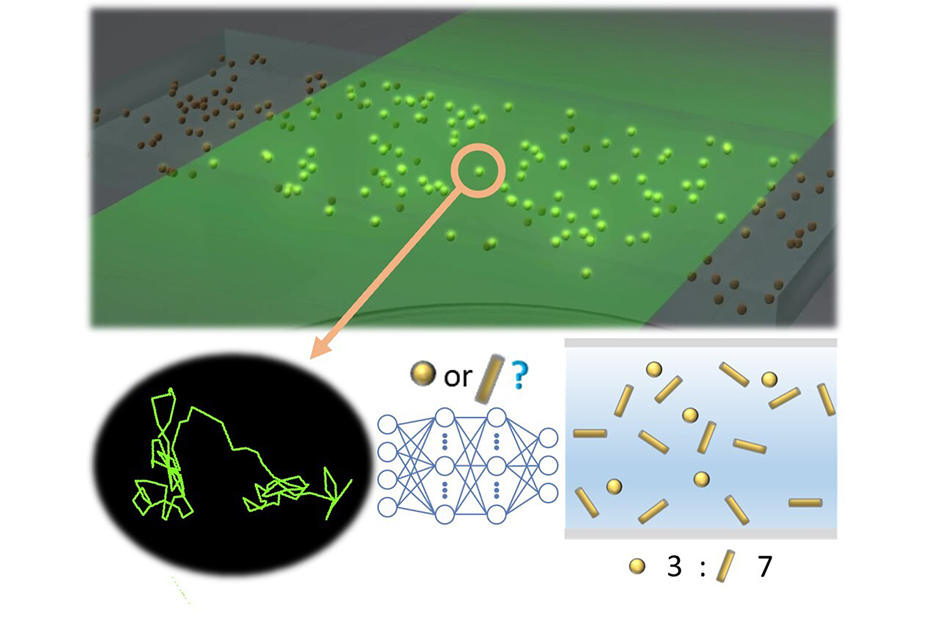
Analysis of Brownian motion trajectories of non-spherical nanoparticles using deep learning
Atomic Scale Structural Identification and Evolution of Co-W-C Ternary SWCNT Catalytic Nanoparticles