A research team has developed a high-throughput computational workflow that pinpoints synthesizable zeolite intergrowth within a vast large design space.
Although some of the zeolite intergrowths are superior to single-phase zeolites as separation membranes or catalysts, their discovery has traditionally depended on trial-and-error experimentation.
Here, the research team took a computational approach. The research team enumerating all possible zeolite-zeolite interface, analyzed their energies, and found two powerful descriptors: (i) the energy difference between the parent frameworks and (ii) the interfacial energy. These descriptors almost perfectly distinguish experimentally realized intergrowths from hypothetical ones. Applying the criteria yielded 192 promising targets. One of them, the zincosilicate pair RSN/VSV, was successfully synthesized.
These findings not only accelerate the discovery of industrially valuable zeolite intergrowths but also advance our understanding of the solid-solid interfaces between dissimilar crystals.

Fig. 1: The schematic figure of the workflow to create the structure model of the zeolite-zeolite interface.
Papers
Journal: Nature Materials
Title: Drawing Boundaries between Feasible and Unfeasible Zeolite Intergrowths using High-Throughput Computational Screening with Synthesis Validation
Authors: Kota Oishi, Koki Muraoka*, Satoko Toyama, Takeshi Iwata, Takehito Seki, Naoya Shibata, Kenta Iyoki, Toru Wakihara, Tatsuya Okubo, Akira Nakayama*
Linking synthesis and structure descriptors from a large collection of synthetic records of zeolite materials
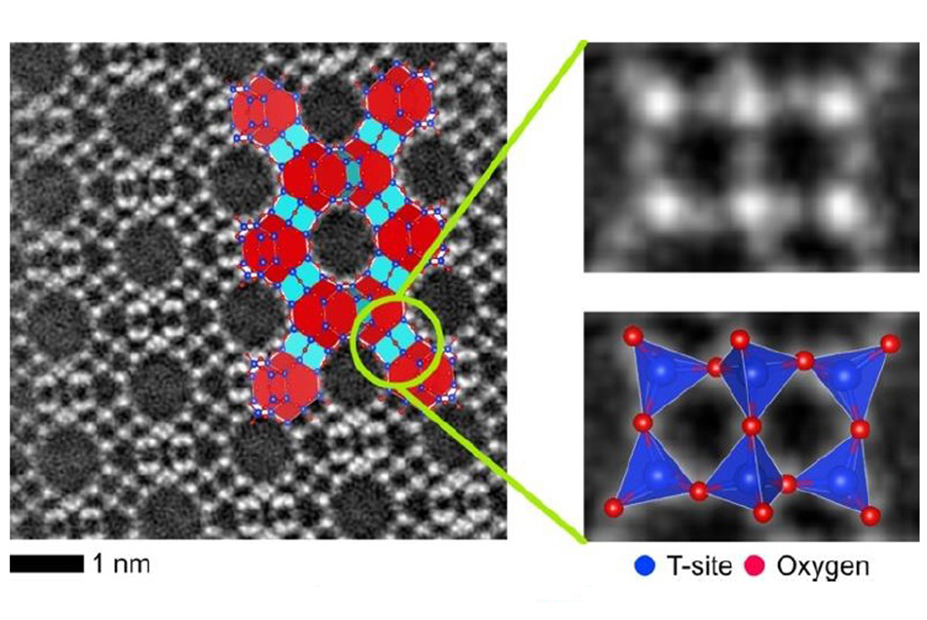
Direct imaging of local atomic structures in zeolite using optimum bright-field scanning transmission electron microscopy