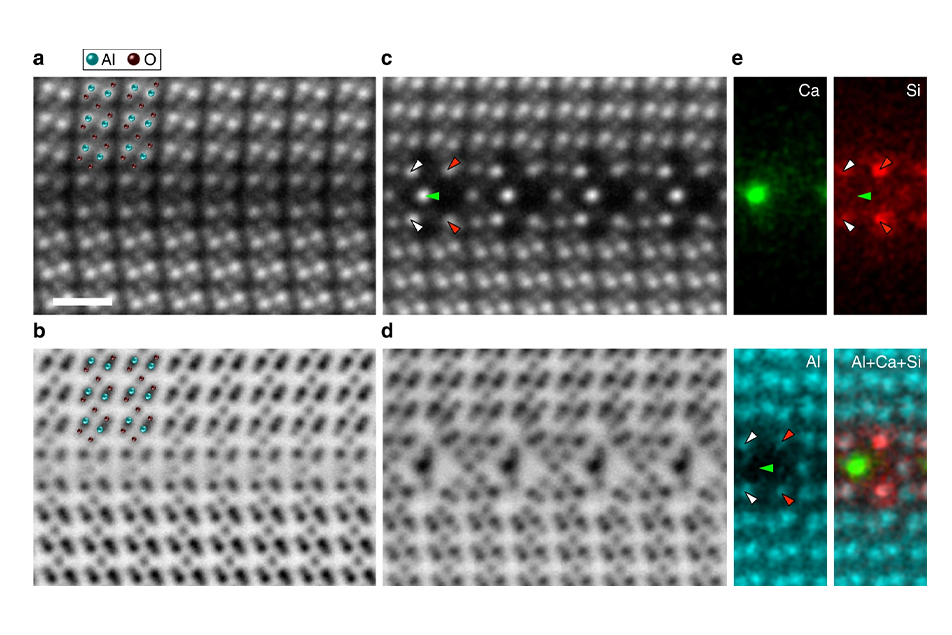
A research group from the University of Tokyo, in collaboration with Tohoku University and Nagoya University, revealed a fast dopant diffusion mechanism along grain boundaries (GBs) using atomic-resolution electron microscopy combined with theoretical calculations. Impurity doping significantly improves the properties of polycrystalline ceramics. So far, GBs have been considered as the fast diffusion pathways of dopants, but the atomistic mechanism of the fast GB diffusion remains unclear. In this study, the group successfully observed the atomistic diffusion process of each Hf atom along the α-Al2O3 GB, using time-resolved scanning transmission electron microscopy. In addition, the group performed large-scale molecular dynamics simulations using a machine-learning interatomic potential. Through the synergetic collaboration of experimental observations and theoretical calculations, the group revealed the novel GB diffusion mechanism via GB interstitial sites. These findings provide valuable guidelines for designing materials with advanced functionality such as fast ionic conduction along GBs.

Time-resolved STEM images of Hf diffusion within α-Al2O3 GB
(a)-(c) Hf jumps between Al sites. (d)-(f) Hf jumps via interstitial sites.
Papers
Journal: Nature Communications
Title: Direct observation of substitutional and interstitial dopant diffusion in oxide grain boundary
Authors: Toshihiro Futazuka, Ryo Ishikawa*, Tatsuya Yokoi, Katsuyuki Matsunaga, Naoya Shibata, Yuichi Ikuhara*

Discovery of a New Diffusion Mechanism in Ceramics grain boundary: Unveiling the Sintering Mechanism and Establishing a New Guideline for Grain Boundary Engineering
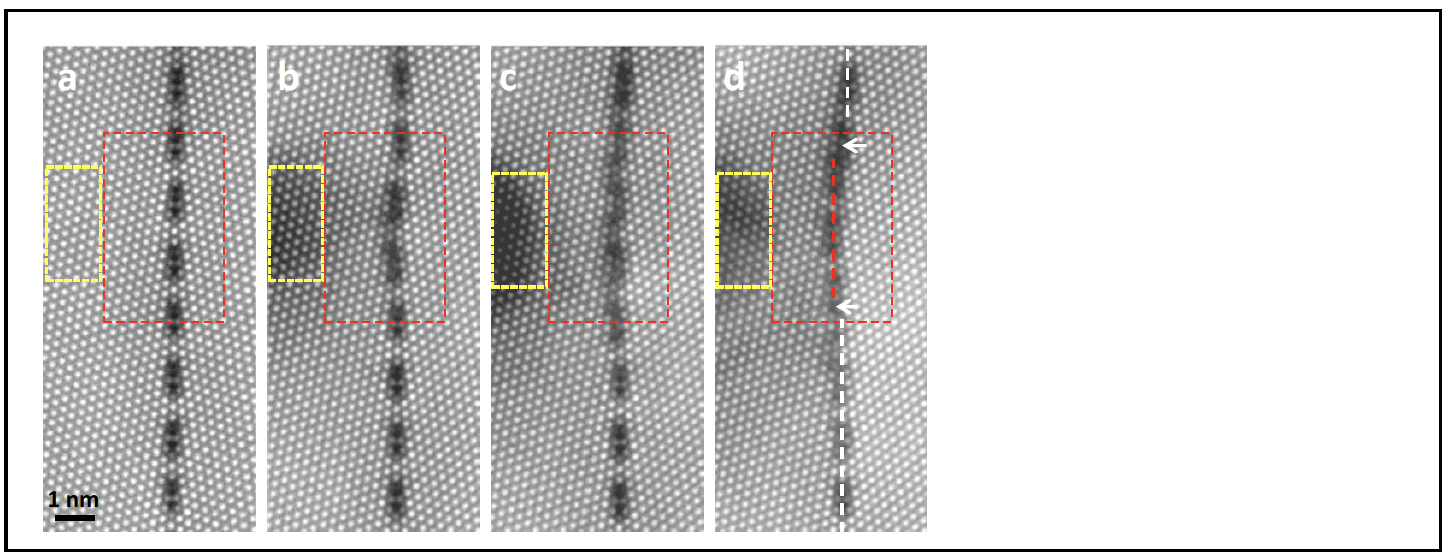
Direct imaging of the disconnection climb mediated point defects absorption by a grain boundary