

As the number of parameters for the AI inference, such as generative AI, the memory capacity required for AI increases. This group have succeeded in achieving both increased memory capacity and 10-year data retention by using MLC (multi-level cell) technology in CiM (Computation-in-Memory) AI accelerator. ReRAM (Resistive Random-Access Memory)-based CiM enables low-power AI inference by integrating data storage and computation.
When increasing the capacity of analog ReRAM, which constitutes the CiM, through multi-level cell storage, there is an issue of memory reliability degradation during the data-retention. In this research, this group propose a method to compensate for the changes in MAC (multiply-accumulate calculation) operations during AI inference that are caused by this ReRAM reliability degradation. This achievement realizes the high AI inference accuracy for over 10 years while also achieving high capacity through multi-level cell storage.
In applications such as mobility, robotics, healthcare, and mobile devices, the need for low-power AI semiconductors is urgent. The proposed technology is expected to expand the use of low-power edge AI accelerator, ReRAM-based CiM in these edge applications, contributing to GX, Green Transformation.


Papers
Conference: IEEE European Solid-State Electronics Research Conference (ESSERC)
Title: Adaptive Oxygen Vacancy Diffusion Compensation in MLC Intermediate States for over 10-year Data-retention of TaOx ReRAM Analog CiM Array
Authors: Yusuke Hirata, Kenshin Yamauchi, Naoko Misawa, Chihiro Matsui, Ken Takeuchi

Resolving the dilemma between hardware scale and computational speed in fault-tolerant quantum computers
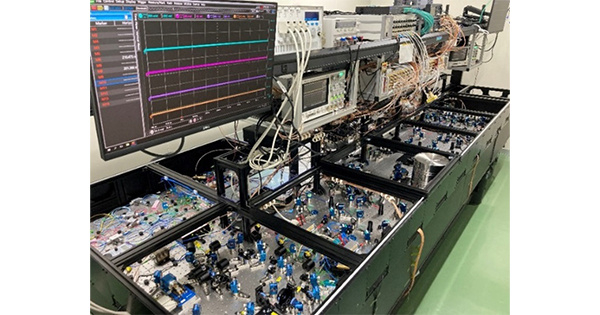
Realization of a new paradigm of universal optical quantum computation platform
