Solar cells are expected to play a key role in a sustainable future, but state-of-the-art halide perovskite solar cells typically rely on lead-containing materials. Developing efficient, lead-free alternatives is therefore an important challenge for next-generation solar-energy technologies. Ge-based halide perovskites are particularly attractive because they exhibit robust ferroelectricity while maintaining strong visible-light absorption, making them promising candidates for novel photovoltaic devices based on quantum-geometric effects.
In this study, the research team discovered an exceptionally large photocurrent in a lead-free halide perovskite, CsGeI3. The team successfully fabricated high-quality epitaxial thin films of this material and found that, under visible-light illumination, it generates a giant “shift current”, a unique form of photocurrent arising from the quantum-mechanical nature of electrons. The observed shift-current response exceeds previously reported values by more than an order of magnitude.
This achievement highlights the promise of ferroelectric halide perovskites as next-generation materials for environmentally friendly solar cells, photodetectors, and other optoelectronic devices.

Papers
Journal: Proceedings of the National Academy of Sciences of the United States of America(PNAS)
Title: Record-high Glass coefficient in the shift current response of a ferroelectric halide perovskite
Authors: Koma Miki, Masao Nakamura, Asahi Yamada, Gurvan Bosser, Kiyohiro Adachi, Daisuke Hashizume, Naoki Ogawa, Satoshi Okamoto, Yoshinori Tokura, Masashi Kawasaki
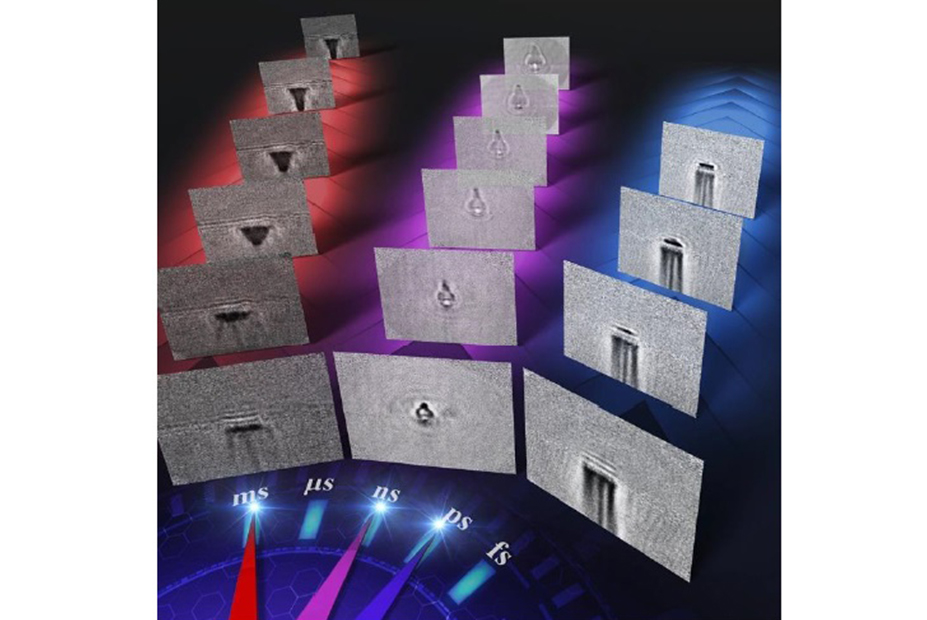
Single-shot optical imaging with spectrum circuit bridging timescales in high-speed photography