A plasmon, the smallest unit (quantum) of collective electron oscillation, can be excited by a short voltage pulse applied to a small electrical contact connected to the electron system and propagates as a wave packet. By encoding quantum information onto plasmon wave packets propagating in quantum circuits, they can be used as “flying qubits”, which may allow for large-scale quantum computation.
The research group has found a novel way to control propagating channel for plasmon wave packets. To operate plasmon wave packets as flying qubits with high fidelity, controlling their intrinsic state, which also determines their velocity, is essential. Previous research demonstrated that the intrinsic state can be controlled by modulating the circuit width. However, in circuits of practical length, uniformly controlling the width is difficult owing to the disorder in the channel. The research group demonstrated that by defining constrictions called quantum point contacts at locations appropriately apart from one another along the circuit and by modulating the width only at these locations, the intrinsic state of the plasmon wave packet can be controlled without changing the width of majority of the circuit. This technology utilizes the fact that the energy of electrons confined within a Fabry-Perot resonator formed between two quantum point contacts can only take discrete values at regular intervals exceeding the energy band of the plasmon wave packets. It should contribute to the realization of large-scale quantum computers based on flying qubits using plasmon wave packets as well as to designing the classical high-frequency circuits.


Papers
Journal: Nature Communications
Title: Eigenstate control of plasmon wavepackets with electron-channel blockade
Authors: Shintaro Takada, Giorgos Georgiou, Junliang Wang, Yuma Okazaki, Shuji Nakamura, David Pomaranski, Arne Ludwig, Andreas D. Wieck, Michihisa Yamamoto, Christopher Bäuerle & Nobu-Hisa Kaneko
DOI: 10.1038/s41467-025-64876-z
Quantum phase transitions in highly crystalline two-dimensional superconductors
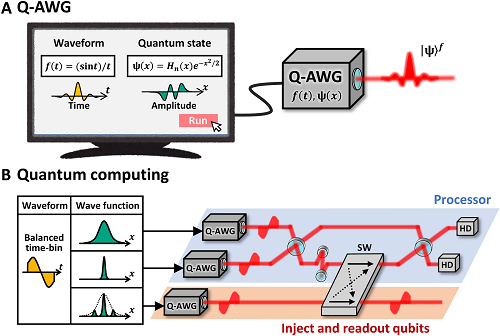
Quantum arbitrary waveform generator